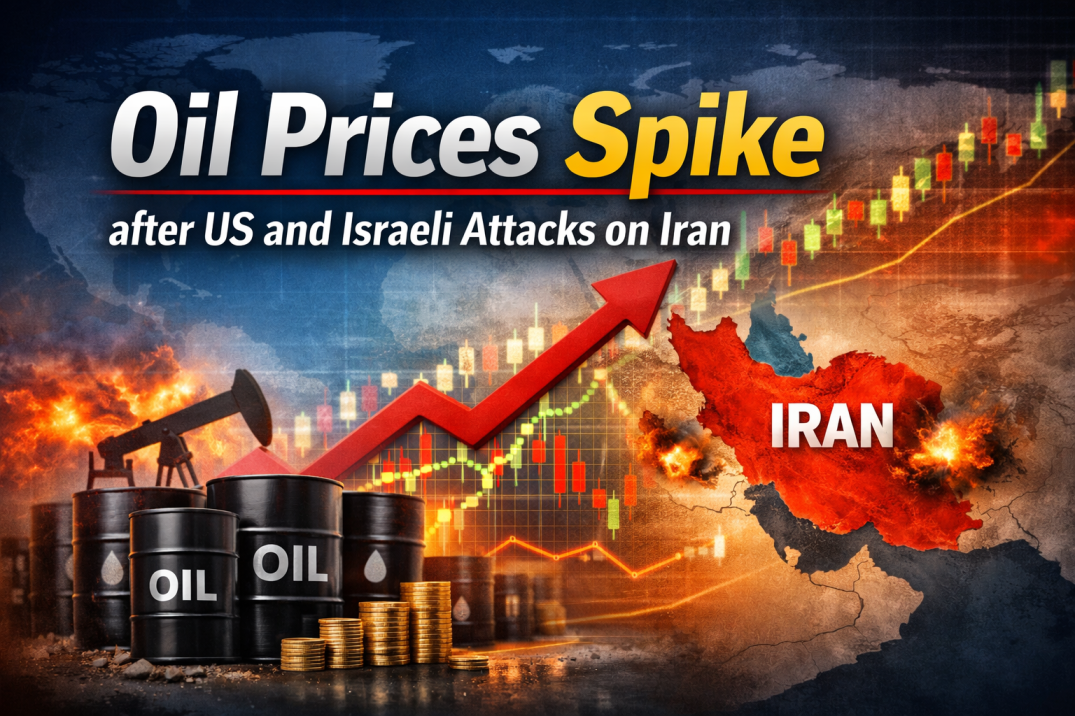
Oil Prices Spike After US-Israel Strikes on Iran
Oil Prices Rise Sharply After US, Israeli Attacks on Iran
Global oil markets reacted strongly this week as oil prices spiked sharply amid military actions involving the United States and Israel against Iran, disrupting critical energy supply routes and stoking fears of broader geopolitical escalation. Analysts say the conflict is already affecting not only energy markets but also consumer fuel costs and global economic stability.
Surge Driven by Geopolitical Risk
Brent crude — the global benchmark for oil — climbed as much as 9–10%, reaching near multi‑month highs, while U.S. West Texas Intermediate (WTI) crude also saw strong gains in early trading sessions. Traders attributed the sharp increase to supply concerns after recent strikes triggered fears of broader disruption across key oil shipping routes like the Strait of Hormuz, a critical chokepoint for nearly one‑fifth of the world’s oil supply.
Markets reacted quickly, pushing oil prices upward as investors assessed the potential impact on global energy flows and tightening supplies. Even limited disruptions in the region can significantly heighten the “risk premium” priced into crude futures.
What This Means for Global Markets
Energy analysts warn that the current situation could keep prices elevated until the conflict shows signs of de‑escalation. Some experts suggest that if tensions persist and exports through strategic waterways remain disrupted, oil could climb further — potentially approaching or exceeding $100 per barrel.
The rise in crude benchmarks also affects global equities, inflation expectations, and transportation costs. Gasoline prices at the pump may climb as suppliers pass increased crude costs to consumers, impacting household budgets and broader economic growth.
OPEC+ and Supply Responses
In response to rising prices, OPEC+ announced plans to increase production by 206,000 barrels per day beginning next month. However, analysts say that boosting output may not fully offset the current geopolitical risk premium if key transit routes continue to face uncertainty.
Governments and refiners worldwide now reassess inventories and alternative supply sources to cushion the impact of potential shortages. Meanwhile, investors track the situation closely, as prolonged instability could have lasting effects on energy markets and inflation globally.
Conclusion
The sharp rise in oil prices after U.S. and Israeli attacks on Iran underlines how quickly energy markets can react to geopolitical tensions. Even in the absence of a full supply cutoff, fears of disruption in the Middle East — especially around the Strait of Hormuz — have already pushed crude costs higher and could keep them elevated in the weeks ahead.
👉 Stay updated with live energy market news, price trends, and expert analysis — follow our site and subscribe for real‑time alerts.